
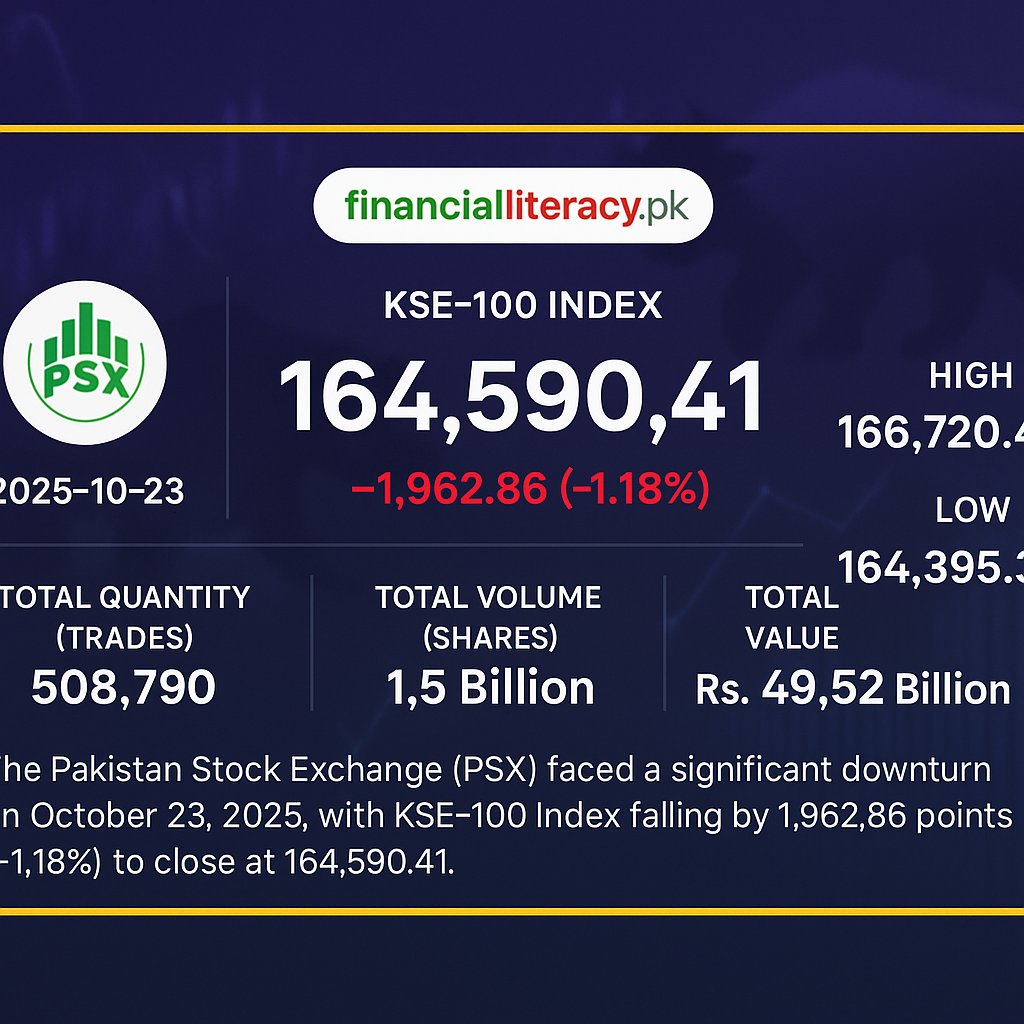
The Pakistan Stock Exchange (PSX) faced a significant downturn on October 23, 2025, with the KSE-100 Index falling by 1,962.86 points (-1.18%) to close at 164,590.41.
Market Overview
On Thursday, October 23, 2025, the Pakistan Stock Exchange (PSX) witnessed a widespread sell-off across sectors, leading to a notable decline in key indices. The benchmark KSE-100 Index shed 1,962.86 points or 1.18% to close at 164,590.41, reflecting cautious investor sentiment.
Index Performance
The KSE-All Share Index lost 969.25 points (-0.96%) to settle at 100,327.41. The KSE-30 Index also dropped by 693.46 points (-1.36%), ending the day at 50,209.81. Meanwhile, the broader KMI-30 Index decreased by 2,915.72 points (-1.21%) to finish at 238,432.13.
Day’s Range
The KSE-100 hovered between a high of 166,720.42 and a low of 164,395.38 during intraday trading, marking a volatile session.
Trading Activity
The day recorded a total of 508,790 trades, with a cumulative volume of 1.5 billion shares traded and a total value of Rs. 49.52 billion. The regular market dominated the activity, accounting for a significant share of the volume and value.
Top Sectors & Companies
The banking and cement sectors were among the most active in terms of volume, whereas oil and gas exploration, fertilizers, and automobile assemblers also saw considerable movement. However, most top sectors witnessed declines, reflecting the bearish undertone.
Market Breadth
Out of all active companies, a higher number ended in the red, with a few managing gains while some remained unchanged, indicating weak market breadth.
Investor Sentiment
Market participants attributed the drop to concerns over economic indicators, regional instability, and profit-taking at higher levels after a strong prior rally.
Outlook
Analysts suggest that investors may look for clues from upcoming corporate earnings reports and macroeconomic data to decide the next direction of the market.