
Sara has a craving for a very specific mango. The rare, honey-sweet kind that only grows on one farm, three hours away.
She could drive there herself. But she doesn’t know the farmer, doesn’t know the going rate, and has no idea how to spot a good mango from a sour one. She’d probably come home with a bad deal and a sunburn.
So she calls her cousin Imran. He’s been buying from that farm for years. He knows the farmer, knows the fair price, and knows exactly which crates to pick. Sara tells him what she wants, and he brings it back. For his trouble, he keeps a small fee.
Imran didn’t grow the mangoes. He didn’t own the farm. He just got Sara access to something she couldn’t easily reach on her own.
That’s a broker. And in the stock market, it’s the only way in.
So what is a stock broker?
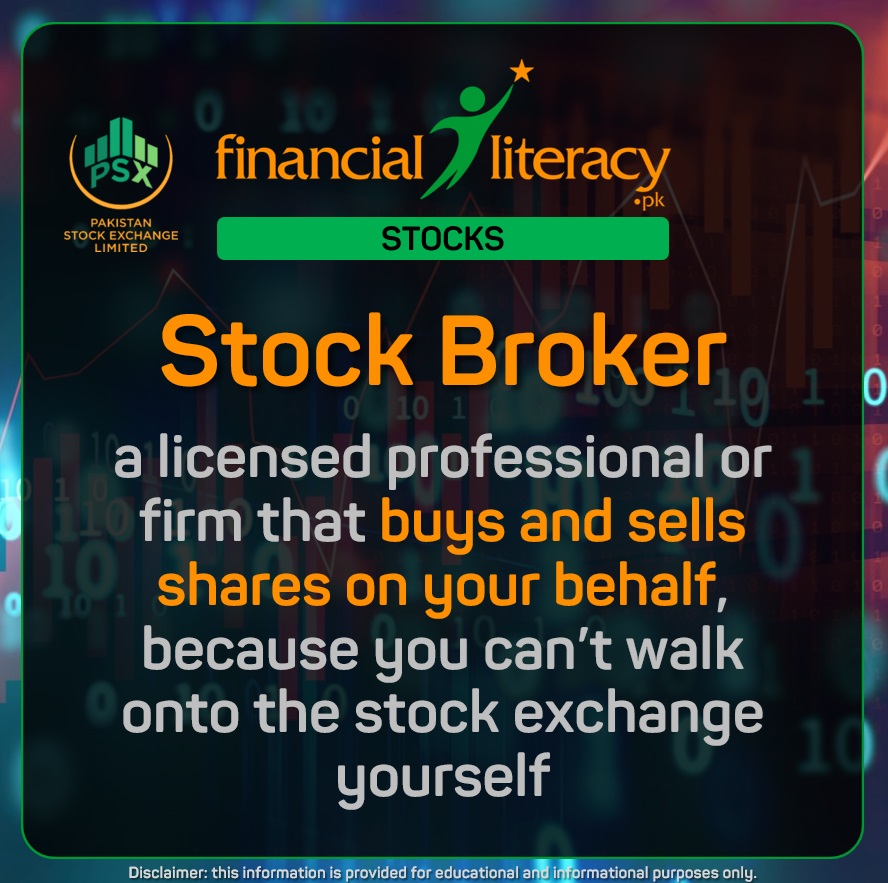
The stock exchange isn’t open to the public. Only licensed members can trade directly on it. These members are called brokers, and they act as the go-between for ordinary investors like you.
You tell your broker what you want to buy or sell, how many shares, and at roughly what price. They place the order on the exchange, get it matched with someone on the other side, and report back to you.
In Pakistan, brokers must be licensed and registered as TREC (Trading Rights Entitlement Certificate) Holder, and they work under the watch of the SECP and the Pakistan Stock Exchange (PSX). If you’ve read about those two, you’ll know why that matters. It means brokers have rules to follow.
How do you get started with one?
You open an account. It’s usually a simple process. You’ll need your CNIC card, some basic details, and a bank account. The broker helps set up your trading account and links it to the systems we talked about earlier, the CDC, which stores your shares, and NCCPL, which settles your trades.
Many brokers now offer mobile apps, so you can place orders from your phone. Some also offer research, advice and market updates.
How do brokers make money?
Not for free, that’s for sure. Usually they charge a commission, a small percentage of every trade you make. Some also charge account fees or other service charges.
This is worth knowing, because the fee isn’t the same everywhere. Two brokers might charge quite different rates for the same trade. Over time, those small differences add up.
What should you look for in a broker?
Start with the basics. Is the broker licensed? Check that they’re registered with the SECP and are a member of the exchange. It only takes a minute, and it’s the single most important thing.
Then look at the costs. Ask about commission rates and any hidden charges.
Check the service too. Is the platform easy to use? Do they answer questions honestly? Do they explain risks, or just push you to buy?
And be careful of any broker who promises guaranteed profits. Nobody can promise that. If someone does, walk away.
A quick example
Say you’ve decided to buy 100 shares of Sunrise Bakery Ltd. at 50 rupees each, which comes to 5,000 rupees.
You log into your broker’s app and place a buy order. The broker sends it to the exchange, where it’s matched with a seller. Once the trade goes through, your broker charges a small commission. Let’s say it’s 0.15%, which comes to 7.50 rupees on this trade. That’s their fee for getting you into the market.
The shares are then settled through NCCPL and land in your CDC account.
A year later, you sell those shares at 60 rupees each, getting 6,000 rupees. Your broker takes another small commission for handling the sale. You keep the rest.
You never met the buyer or set foot in the exchange. Your broker did the legwork, just like Imran did with the mangoes.
The takeaway
A broker is your doorway to the stock market. They don’t guarantee profits and they can’t control prices, but they make it possible for you to invest at all. So choose one carefully, check their license, understand their fees, and never let anyone rush you into a decision. Your money, your rules.