
Remember Ali, Sara and Bilal’s pizza shop? It’s not just about the shares going up in value anymore. Some businesses pay you just for being an owner. That payment has a name, and it’s one of the sweetest parts of investing.
It’s the end of a great year for the pizza shop.
Business boomed. New branches opened. Profits piled up. Bilal calls a meeting with the shareholders, including Hina, the neighbor who bought ten shares, and the student who bought just one.
“We made more money than we need to keep the shop running,” Bilal says. “So we’re giving some of it back. Everyone gets a payment, based on how many shares they own.”
Hina, with her ten shares, gets ten times what the student gets. Fair enough, since she put in ten times as much.
Nobody had to sell a single share to get paid. The money just landed in their accounts, a little thank-you for believing in the shop early on.
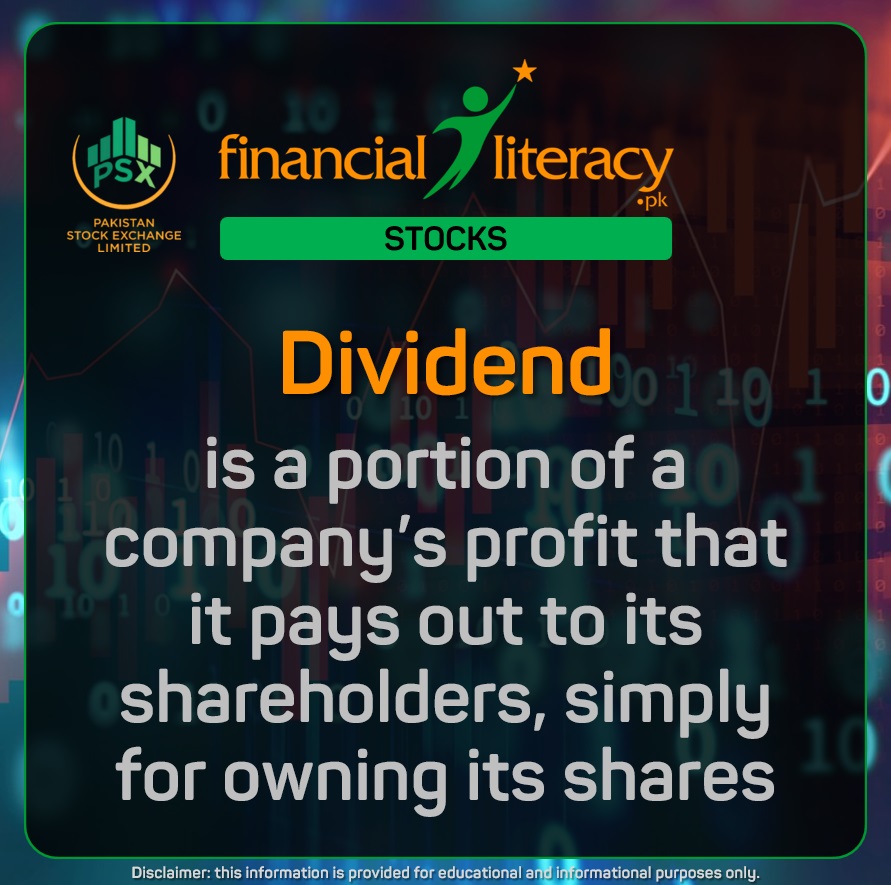
That payment is called a dividend.
So what exactly is a dividend?
When a company makes a profit, it has choices about what to do with that money. It can reinvest it in the business, buying new equipment, opening new branches, hiring more staff. Or it can share some of it with the people who own the company: the shareholders.
The part that gets shared is the dividend. It’s usually paid per share, so the more shares you hold, the more you receive.
Not every company pays dividends. Some prefer to reinvest everything back into growth instead, especially younger, fast-growing companies. Older, more stable businesses, like banks or established manufacturers, tend to pay dividends more regularly.
How does it actually reach you?
The company’s board decides on the amount, usually announced along with the yearly or half-yearly results. This is often expressed as a certain amount per share, say 5 rupees per share, or sometimes as a percentage of the share’s face value.
If you’re a registered shareholder on a specific date, called the record date, you qualify. The payment then gets credited to your bank account, usually linked through your broker and the CDC system we talked about earlier. You don’t need to do anything except hold the shares.
Why do dividends matter to investors?
For one, it’s real cash in your hand, not just a number on a screen that might rise or fall. Even if the share price stays flat for a while, a dividend still puts something in your pocket.
It’s also often a sign of a healthy company. A business that can consistently pay its owners is usually doing something right. Though it’s worth remembering, a dividend today doesn’t promise a dividend tomorrow. If profits drop, the payout can shrink, or stop altogether.
Some investors build an entire strategy around this, buying shares in companies with a strong history of paying dividends, aiming for steady income over the years.
A quick example
Suppose you own 200 shares of Sunrise Bakery Ltd., bought at 50 rupees each, for a total of 10,000 rupees.
At the end of the year, the company announces a dividend of 4 rupees per share. Since you hold 200 shares, you receive 800 rupees, credited straight to your account.
Notice what happened here. You didn’t sell anything. Your 200 shares are still yours, still sitting in your CDC account. You simply got paid for holding them.
Now, if the share price also happened to rise that year, say from 50 to 55 rupees, your shares are worth 11,000 rupees on top of the 800 you already received. Two ways to gain, from the same investment.
Of course, if the company had a rough year instead, it might have skipped the dividend entirely, and the price could have dropped too. That risk never fully goes away.
The takeaway
A dividend is a company’s way of saying, “Thanks for owning a piece of us, here’s a share of what we earned.” It’s not guaranteed, and not every company offers it, but for patient investors, it can turn simple ownership into a steady little reward, year after year.