



Yusuf, the farmer with the wheat field, decides to make a list of everything he owns.
He writes down his land, his tractor, his house, and a small shed full of tools. All real, all things he can touch, stand on, or drive.
Then he pauses. He also has 50,000 rupees in a savings account, some shares in Sunrise Bakery Ltd. he bought a while back, and units in a mutual fund his cousin talked him into.
He can’t touch any of those. There’s no tractor to point at, no shed to walk into. Just numbers on a bank statement and an app on his phone. Yet they’re worth real money, and in some cases, worth quite a lot.
Yusuf has just stumbled onto the difference between physical assets and financial assets.
So what exactly is a financial asset?
A financial asset is something you own that holds value, not because of what it physically is, but because of what it represents: a claim on cash, ownership in a business, or a right to future payments. You can’t use it to grow wheat or live in it. Its worth comes entirely from the agreement or ownership behind it.
Shares, for instance, represent a claim on part of a company, as we covered earlier. Bonds represent a loan you’ve made, with a promise of repayment plus interest. A bank deposit represents money the bank owes you, on demand or after a set period. Mutual fund units represent a share in a pooled basket of other investments.
Compare that to physical assets, sometimes called tangible assets, like land, gold, machinery, or property. These have value because of the physical thing itself. You can see it, touch it, and in many cases, use it directly.
How Pakistan’s NBFC Rules define “assets”
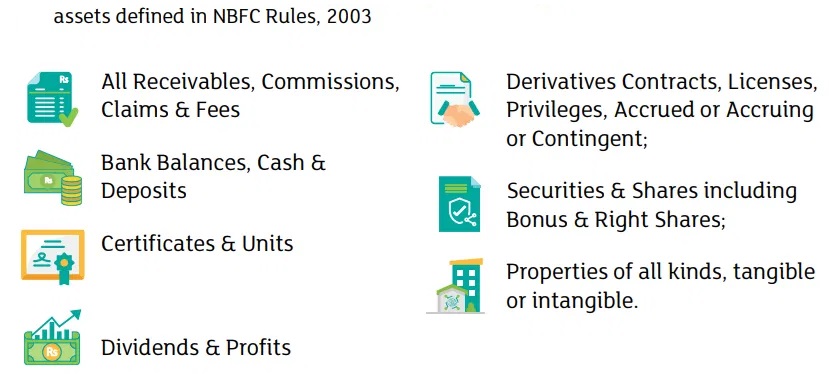
Pakistan’s regulatory framework actually spells this out quite broadly. Under the NBFC Rules, 2003, the definition of assets covers:
- All receivables, commissions, claims and fees
- Bank balances, cash and deposits
- Certificates and units
- Dividends and profits
- Derivatives contracts, licenses, privileges, accrued or accruing or contingent
- Securities and shares, including bonus and right shares
- Properties of all kinds, tangible or intangible
Why does the distinction matter?
Financial assets tend to be easier to buy, sell, and divide. You can sell 10 shares out of 100 without any trouble. Try selling 10% of a tractor. It doesn’t really work that way.
Financial assets are also usually easier to track and transfer, especially now that most of them exist electronically, through systems like the CDC we talked about earlier. No paperwork trunks, no physical handover required.
They tend to be more liquid too, meaning they can often be converted into cash faster. Selling shares on the stock exchange can take minutes. Selling land can take months.
That said, financial assets carry their own risks. Their value depends on the performance of a company, the reliability of a borrower, or the overall market, and that value can rise or fall, sometimes quickly. Physical assets have their own risks too, like damage, theft, or a drop in demand, just of a different nature.
What are the main types of financial assets?
A few come up again and again. Shares, representing ownership in a company. Bonds, representing a loan to a company or government. Bank deposits, representing money held safely with a bank, usually earning some interest. Mutual fund units, representing a slice of a professionally managed, pooled investment. Insurance policies and pension savings can also count as financial assets, since they represent a future financial claim or benefit.
Most investors end up holding a mix of these, rather than just one type, depending on their goals and how much risk they’re comfortable with.
A quick example
Suppose you have 500,000 rupees to put to work.
You put 200,000 into shares of a few different companies. That’s a financial asset, representing part-ownership in those businesses, with value that can rise or fall based on how they perform.
You put 150,000 into a mutual fund. Also a financial asset, representing your share of a larger, professionally managed pool of investments.
You keep 100,000 in a savings account. A financial asset too, representing money the bank owes you, which you can withdraw when needed.
And with the remaining 50,000, you buy a small amount of gold jewelry. That’s a physical asset. Its value depends on the weight and price of gold itself, not on any company or promise of repayment.
A year later, you check on everything. Your shares might be up 10%, your mutual fund up 8%, your savings account has earned a small, steady interest, and your gold has gone up or down depending on the gold market. Each asset moved differently, for different reasons, because each one is a different kind of claim on value.
The takeaway
Financial assets are forms of value you can’t hold in your hand, shares, bonds, savings, mutual fund units, but they’re often easier to buy, sell, and divide than physical assets like land or gold. Most solid financial plans end up including a mix of both, since each type brings its own strengths, risks, and role to play.