

Every cricket season, fans argue about which player is having the best year.
Nobody sits down and studies every player in every domestic match across the country. That’s far too much. Instead, everyone just checks the top-order rankings, a shortlist of the best-performing players, updated regularly. One glance, and you know who’s in form.
The Pakistan Stock Exchange has its own version of that shortlist. Not players, but companies. And that shortlist has a name: the KSE-100 Index.
So what exactly is the KSE-100?
We already know that a stock exchange index tracks a basket of companies to represent the wider market. The KSE-100 is Pakistan’s main index. It includes around 100 companies, selected from different sectors like banking, cement, textiles, oil and gas, and more.
These aren’t just any 100 companies. They’re generally the largest by market value and the most actively traded on the exchange. Together, they make up a big share of the exchange’s total activity, so their combined movement gives a fair picture of the market as a whole.
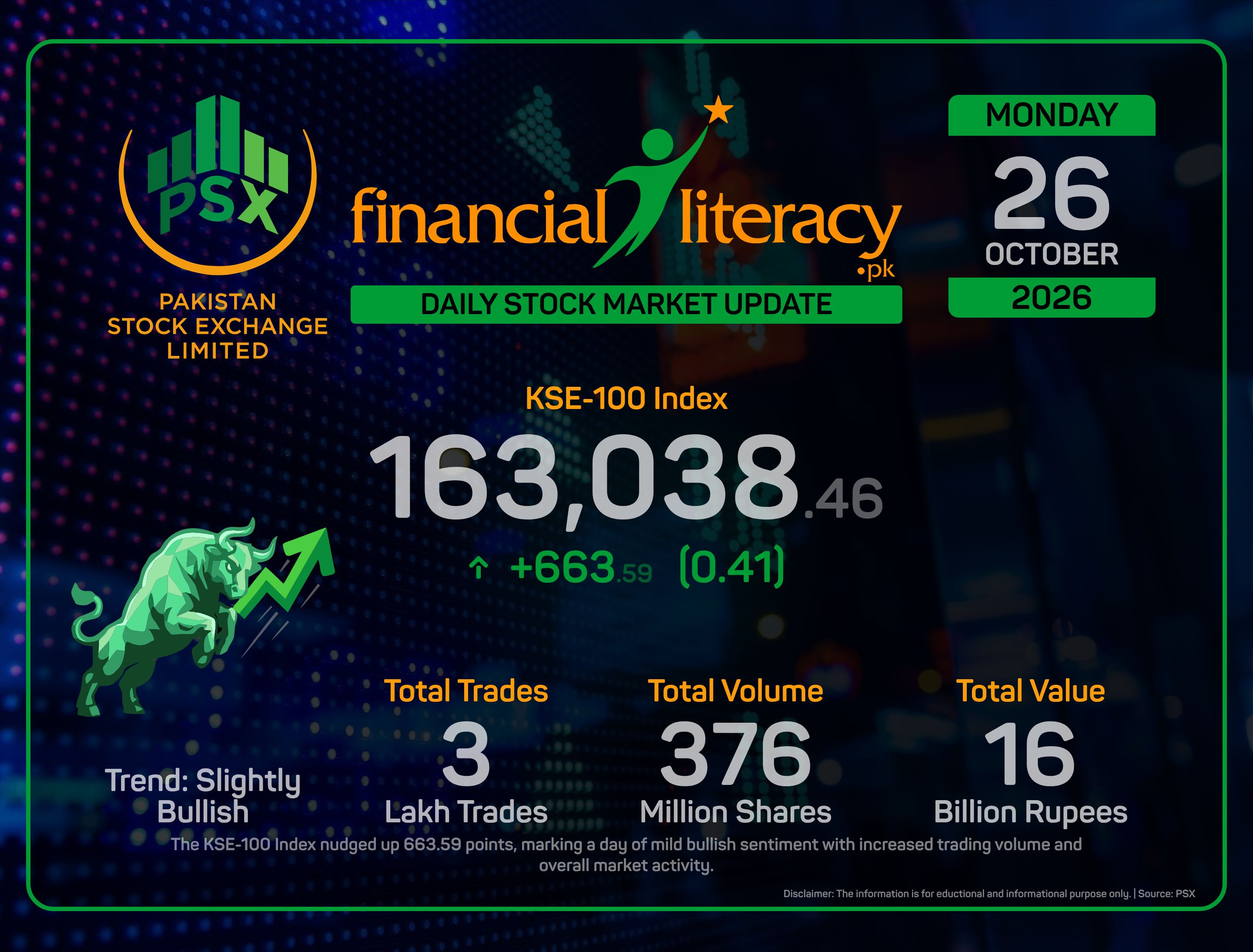
When news anchors say, “the market gained 400 points today,” they’re almost always quoting the KSE-100.
How is it calculated?
The details get technical, but the core idea is simple. Each company in the index carries a certain weight, largely based on its market value, meaning bigger, more valuable companies influence the index more than smaller ones.
As share prices of these companies rise or fall during the day, the index recalculates and moves along with them. A strong day for the large, heavily weighted companies can push the whole index up, even if a few smaller companies in the basket had a rough day.
The list of companies in the KSE-100 isn’t frozen forever either. It gets reviewed and updated periodically, so companies can be added or removed as their size and trading activity change over time.
Why does the KSE-100 matter so much?
It’s the quickest way to check the market’s mood. Instead of scrolling through hundreds of individual share prices, investors, journalists and analysts glance at the KSE-100 and get an instant read: up, down, or flat.
It’s also used as a benchmark. Fund managers and investors often compare their own returns against the KSE-100 to see whether they’re doing better or worse than the broader market. If your investments grew 8% in a year, but the KSE-100 grew 15%, that’s useful context.
Over the long run, tracking the KSE-100’s trend also shows how the Pakistani stock market has generally performed, beyond the noise of any single day.
What the KSE-100 doesn’t tell you
It’s a summary, not the full story. Your own shares might be rising even on a day the KSE-100 falls, or the other way around, depending on whether your particular company is part of the index and how it performed. It also doesn’t cover every single listed company, only the roughly 100 selected ones. Smaller, less active companies outside that list won’t show up in its movement at all.
A quick example
Suppose the KSE-100 closes at 45,000 points on Monday. Over the week, several large banks and one major cement company post strong profits, and their share prices climb. A few smaller companies in the index have a quiet week, prices barely moving.
Because the banks and the cement company carry significant weight, their gains dominate. By Friday, the index closes at 45,900 points.
The news reports, “KSE-100 gains 900 points this week.” If you happened to hold shares in one of those banks, you likely saw solid gains too. But if your only holding was in a company that isn’t even part of the KSE-100, your own results might look completely different, better or worse, regardless of what the headline number says.
The takeaway
The KSE-100 is Pakistan’s main scoreboard for the stock market, built from around 100 of its largest and most active companies. It’s a handy shortcut for gauging the market’s overall direction and a common benchmark for comparing returns, but it’s still a summary. Your own investments can move differently, so it’s worth checking your own numbers, not just the headline points.
Other PSX indices worth knowing
The KSE-100 isn’t the only index on the Pakistan Stock Exchange. A few others come up often:
- KSE-30 Index: Tracks a smaller group of 30 highly liquid, free-float weighted companies. It’s used alongside the KSE-100 for a slightly different read on the market’s most actively traded names.
- KMI-30 Index: Tracks 30 Shariah-compliant companies, screened according to Islamic finance principles. It’s the go-to benchmark for investors who want their portfolio to follow those guidelines.
- All Share Index: Covers every single company listed on the PSX, not just a selected basket. It’s broader but less commonly quoted than the KSE-100.
- Sector indices: The PSX also runs indices for individual sectors, like banking, oil and gas, or cement, so investors can track how a specific industry is performing on its own.
Each of these serves a different purpose, but the KSE-100 remains the one most widely quoted as “the market,” simply because it’s the broadest snapshot most people use day to day.