
Imagine a government-backed project that needs funding to build a toll road.
The usual way to raise that money would be a bond: borrow from investors, promise fixed interest, repay the principal later. Simple, except for one problem. Interest, in the conventional sense, isn’t permitted under Islamic finance principles.
So the structure gets reimagined. Instead of lending money and earning interest, investors are offered a share in the ownership of the road itself, along with a portion of the toll revenue it generates once it’s built and operating. Investors aren’t lenders anymore. They’re part-owners of something real, earning a return from what that asset actually produces.
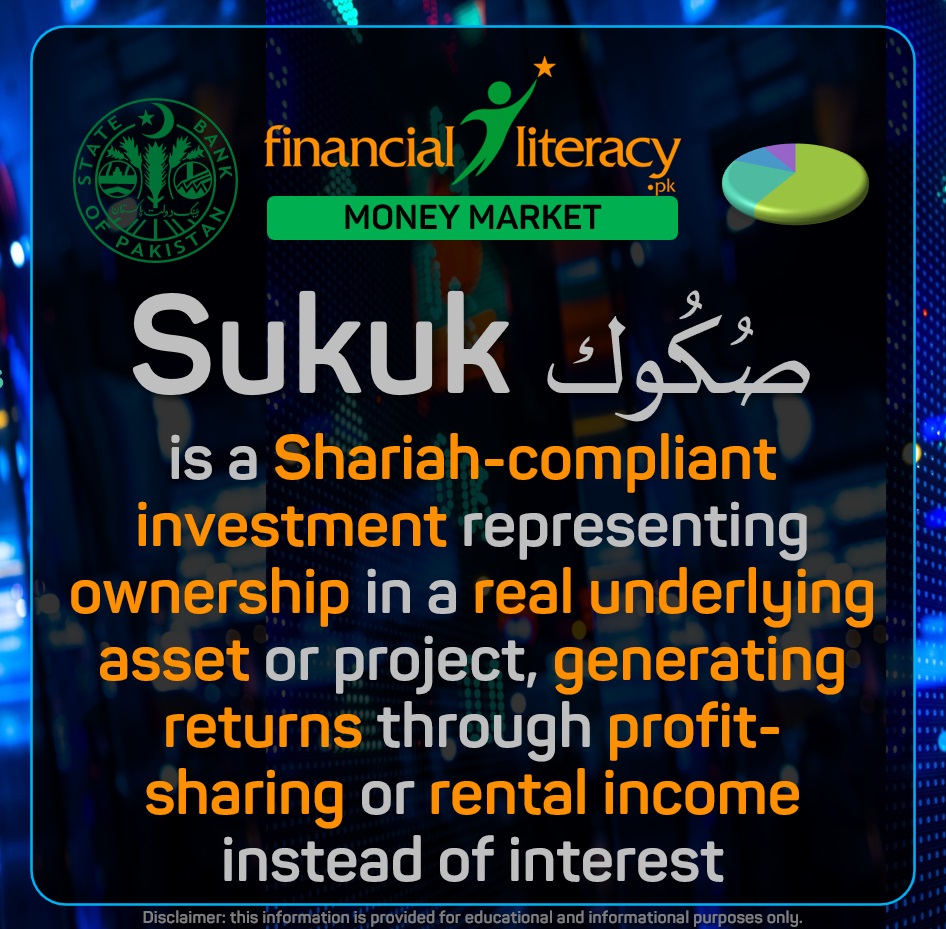
That reimagined structure is called a Sukuk.
So what exactly is a Sukuk?
The word Sukuk (صكوك, plural of Sakk, صك) literally translates to “legal instruments,” “deeds,” “cheques,” or “certificates.” in Arabic language.
A Sukuk is often described as an Islamic bond, though that’s a slightly loose comparison. Like a bond, it’s a way for a government or company to raise money from investors. Unlike a bond, it isn’t a loan earning interest. Instead, a Sukuk represents partial ownership in a real, tangible asset, project, or business activity, and the return paid to investors comes from what that asset earns, rent, profit, or revenue, rather than from interest on a loan.
In Pakistan, the government issues Sukuks, often structured as Ijarah Sukuks, commonly backed by government-owned assets such as land or infrastructure. These assets are effectively leased, and the rental income generated gets distributed to Sukuk holders as their return. Corporations can issue Sukuks too, structured around specific business assets or projects.
How is a Sukuk different from a conventional bond?
The core difference comes down to structure and principle. A bond holder is a lender, earning fixed interest regardless of how the underlying business performs. A Sukuk holder is a part-owner of a real asset, earning a return tied to what that asset generates, such as rental income or profit-sharing, structured specifically to avoid interest.
In practice, for many Sukuks, the return can end up looking similar in size to a comparable bond’s interest rate. But the underlying mechanism, ownership and asset-based earnings instead of a straightforward loan, is what keeps it aligned with Shariah principles.
Why would an investor choose a Sukuk?
Mainly for Shariah compliance. Investors who want their money to follow Islamic finance principles can’t invest in conventional interest-bearing bonds, so Sukuks offer a comparable alternative, generally considered safe since many are backed by government assets or stable, income-generating projects.
Beyond that, Sukuks offer many of the same practical benefits as bonds: relatively predictable returns, and a steadier option compared to the ups and downs of the stock market, fitting into the safer portion of a well-balanced portfolio.
What should investors keep in mind?
Sukuks aren’t entirely risk-free. Their safety depends heavily on the underlying asset or project and who’s backing it. A government-backed Sukuk tied to stable infrastructure is generally considered quite safe. A corporate Sukuk tied to a riskier business venture carries more risk, similar to how a corporate bond carries more risk than a government one.
It’s also worth understanding the specific structure of a given Sukuk before investing, since there are different types, Ijarah being one common example, each with its own mechanism for generating and distributing returns.
How can you actually invest in Sukuks?
Government Sukuks (such as Ijarah Sukuks) are typically offered through banks and the SBP’s investment platforms, similar to how PIBs and T-Bills are accessed. You’ll usually need a bank account, CNIC, and to go through your bank’s investment or treasury desk, or in some cases, participate through the primary auction process via a Primary Dealer.
For corporate Sukuks, you’d generally go through a brokerage account, since many are also listed and traded on the Pakistan Stock Exchange, similar to how corporate bonds work.
If you’d rather not pick a specific Sukuk yourself, Islamic or Shariah-compliant mutual funds, which we touched on earlier, often hold a mix of Sukuks and other Shariah-compliant instruments. This gives you diversified exposure through a single investment, managed by a professional fund manager.
Whichever route you choose, it’s worth confirming that the specific Sukuk or fund is certified Shariah-compliant by a recognized Shariah advisory board, since structures can vary.
A quick example
Suppose you invest 100,000 rupees in a government Ijarah Sukuk, backed by a leased government property.
Over the year, that property generates rental income, and your proportional share of it comes out to roughly 9,000 rupees, paid to you periodically as rental distributions rather than interest payments. At maturity, assuming a standard structure, you also receive your original 100,000 rupees back.
You’ve earned a return of about 9%, similar in scale to what a conventional bond might have offered, but structured entirely around real asset ownership and rental income, with no interest involved at any point.
The takeaway
A Sukuk lets investors earn a return without relying on interest, by owning a share of a real asset and earning income from what that asset produces. It offers many of the same practical benefits as a conventional bond, steady, relatively predictable returns, while staying aligned with Islamic finance principles. For investors who want their portfolio to follow Shariah guidelines, it’s one of the main tools available to do that.